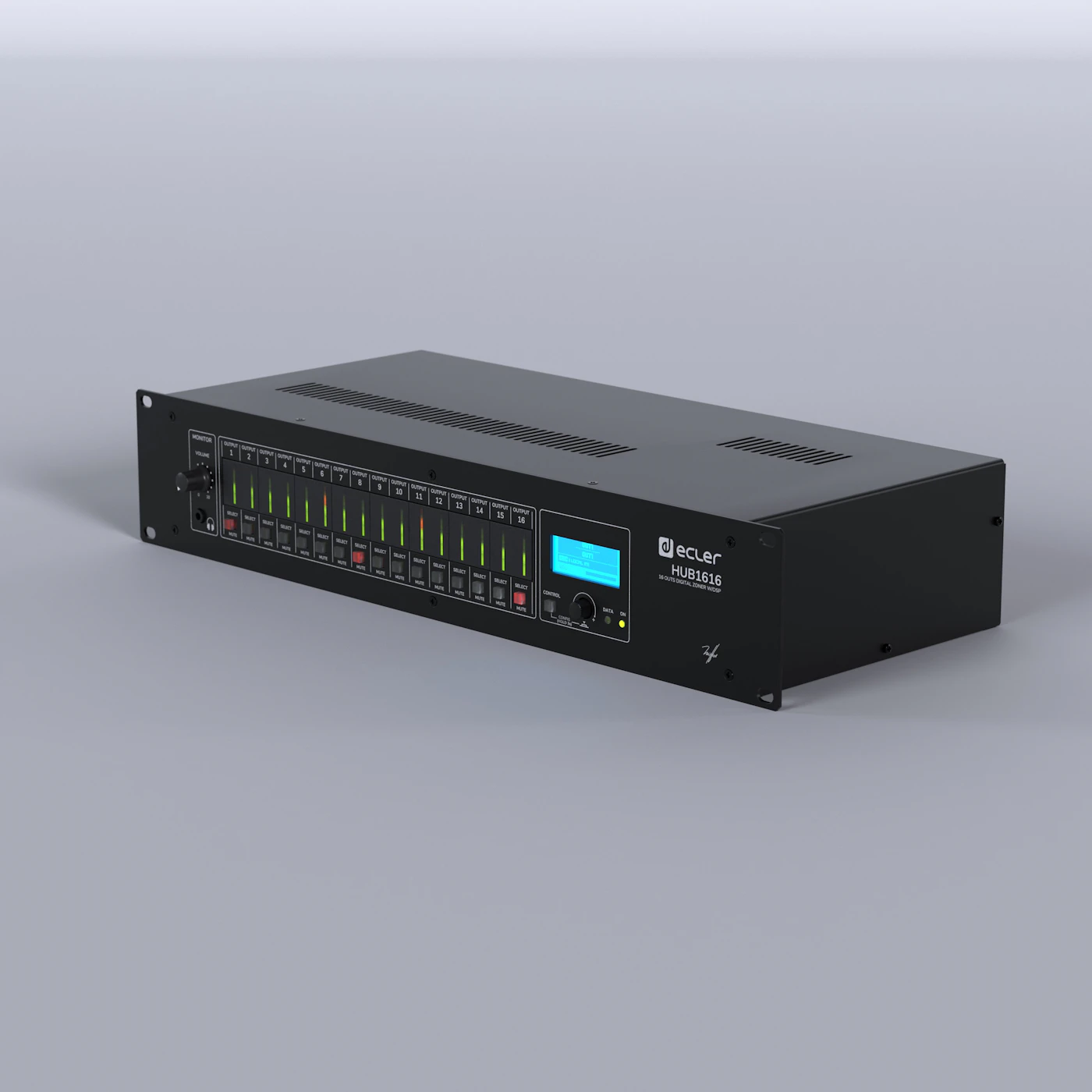
A 100 V line lets you run many loudspeakers on one long cable run without worrying about impedance. This article explains the principle, how to add up loudspeaker power to choose an amplifier, and a worked example with Ecler IC6i in-ceiling loudspeakers and an eHMA mixing amplifier.
When a shop or restaurant needs 10–20 loudspeakers spread across the floor plan, conventional 8 ohm wiring quickly hits its limits: each amplifier channel can only drive a few loudspeakers, and long cables waste power. The 100 V system (also called high impedance, 70/100 V) was created to solve that problem.
How 100 V works
The amplifier sends the signal down the line at a high voltage (up to about 100 V), so the current is small and cable losses are low. Each loudspeaker has a transformer with power taps, for example 2.5 / 5 / 7.5 / 15 W. All loudspeakers are wired in parallel on the same pair of wires; each loudspeaker draws exactly the power of its selected tap.
Advantages over 8 ohm wiring
- Many loudspeakers can be connected on one line, and loudspeakers are easy to add or remove.
- Cable runs of tens to hundreds of metres still use moderate cable cross-sections.
- The level of each loudspeaker is set with its power tap, with no extra equipment needed.
- The calculation is simple: just add up the power of the taps.
How to calculate amplifier power
- Step 1: choose the power tap for each loudspeaker by area (choose a higher tap for noisy areas or high ceilings).
- Step 2: add up all the taps on the same line.
- Step 3: choose an amplifier whose 100 V power is about 20% higher than that total, so the amplifier does not run close to its limit.
Example: a café with 12 in-ceiling loudspeakers
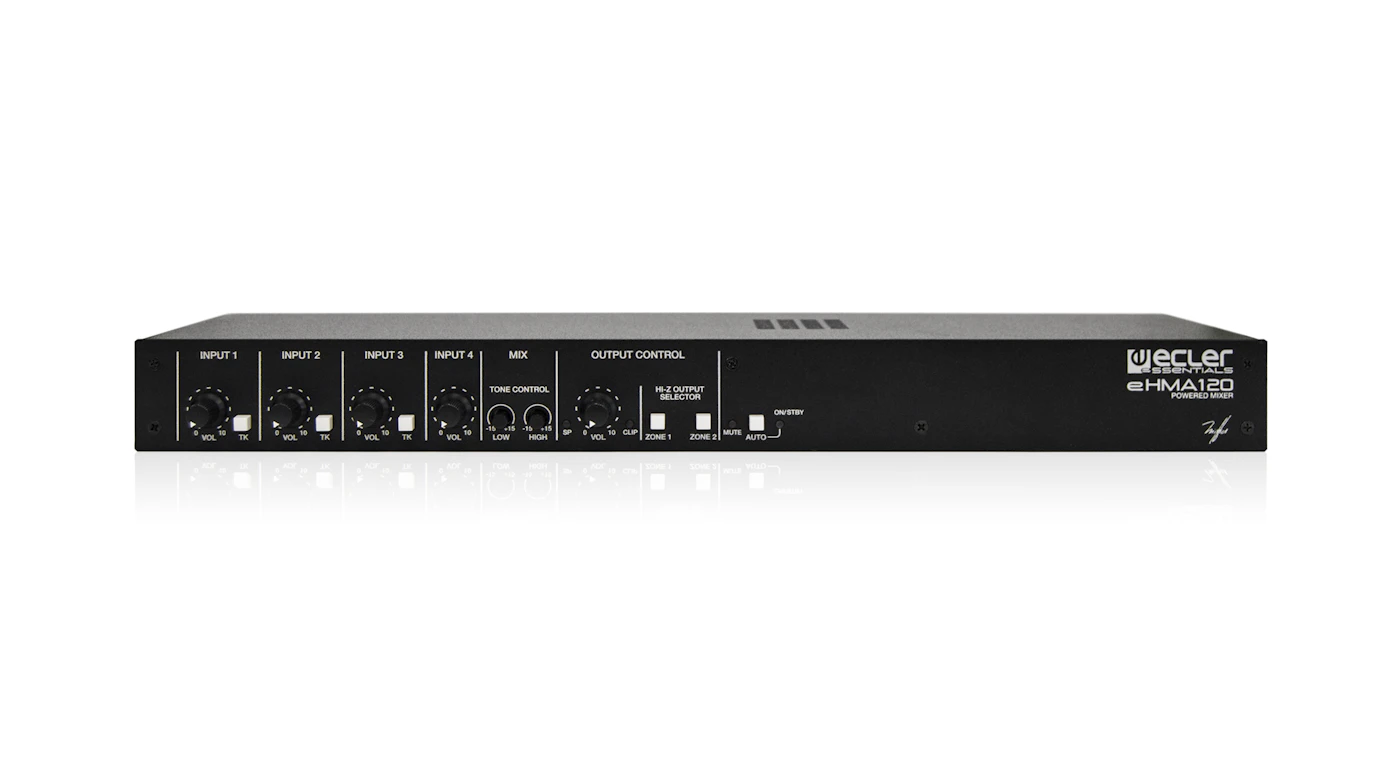
Use 12 Ecler IC6i loudspeakers (100 V taps: 2.5 / 5 / 7.5 / 15 W). With the 5 W tap: the total is 12 x 5 = 60 W, and adding 20% headroom gives 72 W. The Ecler eHMA120 mixing amplifier delivers 95 W at 70/100 V, so it handles this comfortably, and it also has 2 built-in zone on/off switches to separate the indoor area from the terrace.
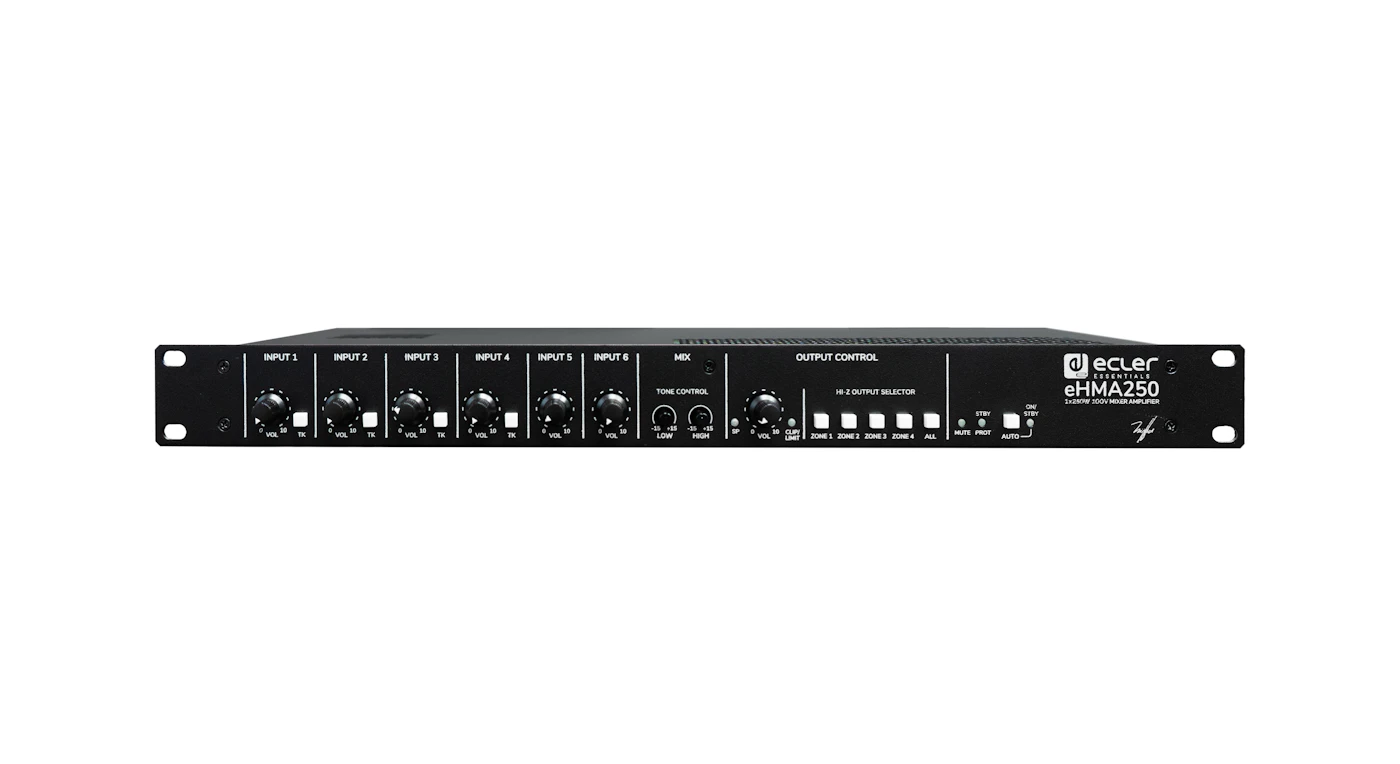
If the café is noisy and needs the 7.5 W tap: the total is 90 W, and adding 20% headroom gives 108 W, which exceeds the 95 W of the eHMA120. In that case, move up to the eHMA250 (250 W, 4 zone switches) to leave room for expansion.

Photo: the terrace of the Pescarus restaurant (Bucharest, Romania), a project that uses an Ecler eHMA250 mixing amplifier to drive eMOTUS8OD outdoor loudspeakers. Photo credit: Ecler.
The three Ecler eHMA mixing amplifiers
- eHMA60: 60 W at 4 ohm or 70/100 V; 1 microphone input and 2 microphone/line inputs; suited to small shops.
- eHMA120: 95 W at 4 ohm or 70/100 V; 3 microphone/line inputs with voice priority, 1 line input, 2 zone switches, with a chime before announcements.
- eHMA250: 250 W at 4 / 8 ohm or 50 / 70 / 100 V; 4 zone switches, and a remote volume control port compatible with WPa range wall panels.
Common mistakes
- Adding up the loudspeakers' rated power (for example 40 W) instead of the selected transformer tap.
- Choosing an amplifier that exactly matches the total power, with no headroom.
- Mixing 8 ohm loudspeakers without a transformer onto a 100 V line.
If you need the calculation checked for a specific floor plan, dealers and contractors can send their drawings to Liza Trading, the Ecler distributor in Vietnam, for configuration advice and support with bills of quantities.